
Updates in Osteoarthritis Research
Arthritis Foundation-supported researchers present their trials.
By Jill Tyrer | April 6, 2026
In this article:
- A Tradition of OA Research
- The Horse-Human Connection
- Focus on Imaging in OA Research
- Predicting Osteoarthritis
- Preventing OA
- Study Participants as Research Partners
- Potential New Treatments
- OA Rehabilitation
- Sports Performance and Research Center
Members of the Arthritis Foundation's Osteoarthritis Clinical Trials Network (OACTN) gathered in Atlanta in late February to hear updates on osteoarthritis (OA) studies funded by the Foundation.
President and CEO Steve Taylor welcomed the physician-scientists, academic researchers and study team staff from institutions across the United States and addressed the larger issue of public health in America. He expressed concerns about the impact of funding and staff reductions at the National Institutes of Health (NIH) and the Centers for Disease Control and Prevention (CDC). Both are facing "challenging times both in funding and infrastructure cuts," he said.
Lindsey Criswell, MD, MPH, was not renewed as director of the National Institute of Arthritis and Musculoskeletal and Skin Diseases (NIAMS), despite her respected leadership, and no permanent replacement had been named, Taylor said, leaving 16 of the 27 National Institutes of Health (NIH) without permanent leaders. The Arthritis Foundation partnered with the American College of Rheumatology to write letters and contact congressional leaders and the director of NIH to express these concerns.
"The Arthritis Foundation has been a steadfast supporter of NIH for many years, but we're also a steadfast supporter of scientists and academic institutions throughout the NIH. I and the Arthritis Foundation continue to speak out against the attack on science and, more importantly, about the attack on the infrastructure of science," Taylor said. People must understand that decisions made today about public health and research will have consequences and impacts on future generations, he added.
The Arthritis Foundation is committed to continuing our support. We currently have a research budget of $14 million per year, up from $10 million about four years ago. We also continue to advocate for more funding for arthritis research and programs in the wake of the elimination of the CDC Arthritis Program.
A Tradition of OA Research
Osteoarthritis research that the Arthritis Foundation currently supports started with the Segal North American Osteoarthritis Workshop (SNOW) conferences in the early 2000s, Taylor said. Ideas that took root in those conferences are now in use in current trials.
The Horse-Human Connection
Animal research often doesn't translate well to humans, but Lisa Fortier, DVM, PhD, ACVS, specializes in osteoarthritis research at the cellular and molecular level in horses that may also be useful in humans. As the keynote speaker, Dr. Fortier highlighted research efforts into treatments used in both horses (and dogs) for knee OA over the past several decades, from corticosteroids and the advancement of regenerative medicine to the use of biological agents to repair joints.
The focus is still on the use of biological agents, like platelet-rich plasma (PRP), but scientists are homing in on key molecular and cellular components, including some called platelet-derived exosomes. These are like tiny packages released by platelets that carry proteins, RNA and growth factors. They show promise for controlling inflammation, regrowing tissue and promoting healing. While research has a long way to go, it may eventually apply to human knee OA.
Focus on Imaging in OA Research
A full day of presentations followed, highlighting recaps and updates on clinical trials the Arthritis Foundation supports. The first two sessions focused on approaches to OA imaging and modeling for diagnosis, prognosis and prediction.
-
Don Anderson, PhD, a professor of orthopedics and engineering at University of Iowa's school of medicine, uses weight-bearing computed tomography (WBCT) — a type of imaging taken while a person is standing — in studying post-traumatic OA. OA often develops quickly in people who have had an anterior cruciate ligament (ACL) tear or other knee injury, but we still don't fully understand how. Using WBCT to take pictures of the damaged joint lets scientists get a more detailed picture of how joint tissues like bone and cartilage rub against each other, for example. Subtle changes in the joint after an ACL repair, for example, can affect how a joint moves and the amounts of pressure on different locations in the joint. Building on that data may lead to a better understanding of how those changes lead to early onset OA.
-
Xiaojung Li, PhD, is director of the Program for Advanced Musculoskeletal Imaging at Cleveland Clinic. Her lab is the imaging core center for the Preventing Injured Knees from Osteoarthritis Severity Outcomes (PIKASO) trial, one of the Arthritis Foundation-supported landmark clinical trials. The lab collects and analyzes X-rays and MRIs collected as part of the study and is building a repository of images for additional research. She is also a principal investigator for a long-term trial looking at structural changes and OA pain 10 years after ACL reconstruction. This Multicenter Orthopaedic Outcomes Network (MOON) study has followed thousands of patients, collecting imaging biomarkers and other data after ACL reconstruction. Dr. Li and Kurt Spindler, MD, are collaborating on the follow-up MOON-MRI project. Dr. Spindler is associate chief of clinical research at Cleveland Clinic and co-chair, with David Felson, MD, MPH, of the OACTN Steering Committee. He is also a site principal investigator for PIKASO and a recent recipient of the Arthritis Foundation's Howley Prize. Drs. Li and Spindler are collecting functional MRI imaging of the brain and knee to determine if there is a relationship between quantitative MRI and OA pain. They are using radiomics to analyze changes to better understand how OA develops and help predict who might be at risk after ACL reconstruction.
Predicting Osteoarthritis
In the second session, Cara Lewis, PT, PhD, and Michael Willey, MD, addressed the prediction and development of hip OA.
-
Dr. Lewis, a professor of physical therapy at Boston University School of Medicine, is studying hip osteoarthritis risk in young women athletes in soccer, ice hockey, dance and distance running. Her lab assessed them for pain, movement and the presence of dysplasia and femoroacetabular impingement (FAI). These are both conditions in which the ball-and-socket joint of the hip doesn't fit well together, contributing to pain, soft tissue degradation and higher OA risk. It appears that sports demands contributed to the hip injuries, especially in hockey and soccer. These athletes build power but not biomechanical control, leading to the injuries, Dr. Lewis said. The challenge is to restore the normal development of their hips without surgery, reducing the risk of hip OA. "How can I train them out of what their sport has trained them into?" she said.
-
Dr. Willey, an orthopedic surgeon and associate professor at the University of Iowa, focuses on hip dysplasia, a condition in which the ball of the hip fits too loosely in the hip socket. Surgery might appear to correct it, but surgical correction also alters hip biomechanics in less obvious ways. As a way of trying to predict hip OA risk, he and his team, including Dr. Jessica Goetz, are using computer models to measure contact and pressure points within the joint, and what conditions lead to degeneration and earlier OA.
Preventing OA
Osteoarthritis is the most common form of arthritis but, unlike for other forms, there are no disease-modifying treatments that can slow or stop the disease from progressing. So Morgan Jones, MD, MPH, and Steve Messier, PhD, are looking at preventing OA. Each discussed two landmark clinical trials focusing on different approaches to OA prevention.
-
Preventing Injured Knees from Osteoarthritis Severity Outcomes (PIKASO) is a multicenter trial studying whether the drug metformin can help prevent knee OA, explained Dr. Jones, an orthopedic surgeon at Mass General Brigham and a co-principal investigator with Cale Jacobs, PhD, ATC. Metformin, commonly prescribed to treat type-2 diabetes, may also reduce pain and inflammation and help preserve cartilage and slow degradation. In the study, taking place at nine sites across the country, participants who are scheduled for ACL reconstruction due to a torn ACL — raising their risk of early OA — are receiving either metformin or placebo. They are being assessed for pain and structural damage to see if metformin can reduce pain and damage in a two-year period after ACL surgery.
-
Dr. Messier, professor and director of the J.B. Snow Biomechanics Lab at Wake Forest University — well known for his extensive research in exercise, nutrition and weight loss to reduce OA symptoms — is principal investigator of The Osteoarthritis Prevention Study (TOPS). Because there still is no cure for OA short of joint replacement, Dr. Messier is focusing on prevention by providing a structured weight loss and exercise program for women over 50 with overweight or obesity. A key component of the study is the social support and encouragement the women receive, he said. The intervention is focusing on making healthy exercise and dietary lifestyle changes that stick. Dr. Messier expects to finalize recruitment of about 1,200 women over 50 years old this summer. TOPS has given rise to additional research questions, including one that is looking at whether muscle power can predict knee OA.
Study Participants as Research Partners
Engaging patients more actively as partners in clinical trials, rather than just participants, is the focus of the Patient Advisors Team in Orthopaedic Research PARTNORS Program at Missouri Orthopaedic Institute. Lisa Royse, PhD, MEd, is co-director of the program and patient engagement officer of a research network funded by the Patient-Centered Outcomes Research Institute (PCORI), whose mission is to ensure patient voices are central to research. She explained how building this infrastructure has strengthened their OA research.
People with lived experience of OA are encouraged to bring their input to research in a meaningful way, including writing their own research questions. This approach helps keep patient and caregiver priorities at the forefront and provides insights that influence a trial's design, the ability to recruit and retain participants, and even funding, she said. Dr. Royse's research is not funded by the Arthritis Foundation, but her findings could help promote participant recruitment and retention in clinical trials.
PARTNORS includes about 10 patient partners who attend and lead regular meetings and frequent updates with encouragement to weigh in. Among other points, it helps address the challenge of knowing when the time is right for joint replacement — a question physicians often can't answer well. Those with lived experience as patient and caregiver can help inform that answer and provide insights that are relevant to different people. The program also has helped advance progress in Columbia University's initiative to grow a living joint. "We often lose sight of what matters to patients," Dr. Royse said. This approach "builds research for patients and not at patients."
Join a Clinical Trial
Potential New Treatments
Three presentations focused on promising OA treatments, or "emerging interventions."
-
Austin Stone, MD, PhD, director of Kentucky University's Center for Cartilage Repair and Restoration, discussed the Montelukast as a Potential Chondroprotective Treatment Following Anterior Cruciate Ligament Reconstruction (MOCHA) trial. This looked at using the allergy medication montelukast (Singulair) to prevent the loss of cartilage — and reduce the risk of OA — after ACL surgery. On a cellular level, the drug blocks leukotrienes, molecules that trigger inflammation, leading to cartilage damage and OA. The trial involves taking medication regularly, which is an inherent challenge for participants — plus the patient burden of long-term follow-up, Dr. Stone pointed out. This led to discussions about ways to revise the study plans to facilitate follow-up and complete the study.
-
Morgan Jones, MD, returned to the podium to discuss the Corticosteroid Meniscectomy Trial (CoMeT) trial. CoMeT tested whether a long-acting form of the corticosteroid triamcinolone, which tamps down inflammation, could prevent further damage and improve pain and function after partial meniscectomy. This surgery — to remove part of a torn meniscus, a cartilage ring in the knee — is common and is often followed by early onset OA. Another goal was to try to identify biomarkers associated with changes in pain and function, and which biomarkers might predict a patient's pain and response to the drug. The multi-center study compared patients with partial meniscectomy who received the drug to those who received placebo. Researchers assessed their pain level, MRI and X-ray images, blood and urine biomarkers and more. The final stage of the study is underway. In addition to testing the effectiveness of this drug, this will be the first study to look at joint fluid and tissue biomarkers as ways of predicting partial meniscectomy outcomes.
-
Miguel Otero, PhD, associate scientist in the Hospital for Special Surgery's Orthopedic Soft Tissue Research Program and associate professor at Weill Cornell Medical College, discussed a new study exploring whether concentrated bone marrow aspirate helps regenerate cartilage after ACL reconstruction. ACL surgery can repair the ligament, but there often is also cartilage damage that isn't helped. This study is changing the joint environment by adding bone marrow mesenchymal stromal cells (BMSCs) — the kind of cells that can form into different kinds of tissues. The question is whether that concentrate injected into a joint could help repair the cartilage and reduce the risk of developing OA.
OA Rehabilitation
The conference's Rehabilitation and Outcomes session highlighted two studies, one focusing on biomechanics following knee injury and another on physical activity after total knee arthroplasty.
-
Brian Pietrosimone, PhD, ATC, professor of athletic training and director of the MOTION Science Institute at the University of North Carolina at Chapel Hill, discussed multiple projects on biomechanical changes following knee injury, and the onset of post-traumatic osteoarthritis (PTOA). He explained that a previous study had helped show that, after ACL reconstruction, people tend to walk and move differently. This changes how the joint bears weight, or "joint loading," which could create or worsen pain and accelerate the onset of OA. Plus, changes in one limb can affect the uninjured limb, leading to additional joint problems. The current study aims to identify specific time points and biomarkers that could be used to help correct a person's biomechanics early enough to potentially reduce the risk of PTOA.
-
Elena Losina, PhD, professor of orthopedic surgery at Brigham and Women's Hospital and Harvard Medical School, is principal investigator of the Knee Arthroplasty Activity Trial (KArAT). People with OA are often sedentary, partly due to OA pain and other symptoms. But even after joint replacement surgery, when their OA pain should be gone or greatly reduced, they don't usually increase their activity. Dr. Losina is studying whether encouragement and financial incentives could increase their activity levels, which could also improve their OA symptoms and overall health. As an offshoot, Dr. Losina's team is also looking at fall risks among patients with a history of knee replacement. Falls occur at higher rates in the first year after joint replacement due in part to muscle weakness and balance issues.
The meeting concluded with a final session presented by the PIKASO biospecimens subcommittee, under the direction of Virginia Kraus, MD, and Janet Huebner, MS, from Duke University. Discussion centered around the potential wealth of information there is to learn from biospecimens collected as part of the PIKASO trial. These include urine, blood and joint tissue collected at several points over the two-year study period, and the potential impact that biomarkers can have for precision medicine for people living with osteoarthritis.
Sports Performance and Research Center
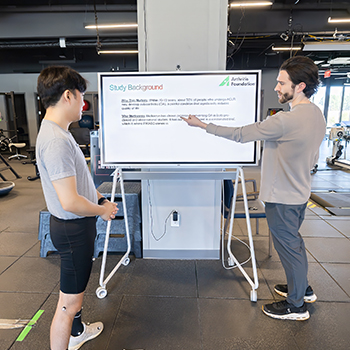
Some of those attending the conference also traveled to Emory Healthcare's Sports Performance and Research Center (SPARC), under the direction of Gregory Myer, PhD, about 45 minutes outside of Atlanta. The center is a state-of-the-art research center that also serves as the training center for the Atlanta Falcons NFL team and as an orthopedic clinic for the local community.
Scientists are using the research center for a variety of trials, ranging from concussion assessment in athletes to back pain in veterans. It is also one of the sites for the large-scale, multi-center PIKASO trial. It looks like a well-equipped fitness center — but jacked up with cameras, computers and technology you wouldn't see anywhere except a research center.
Athletes use virtual reality goggles to go through sports movements as cameras and software track their biomechanics in numerous ways, producing a plethora of data points per movement. Not only are researchers at SPARC tracking the way the body moves, but a specialized MRI allows them to monitor brain activity while a participant is performing certain movements — for comparisons before and after ACL surgery, for example. The resulting data could feed trials that are potential game changers for people living with joint issues and osteoarthritis risk.
Sports Performance and Research Center
Sports Performance and Research Center
Sports Performance and Research Center
Sports Performance and Research Center
Sports Performance and Research Center



Stay in the Know. Live in the Yes.
Get involved with the arthritis community. Tell us a little about yourself and, based on your interests, you’ll receive emails packed with the latest information and resources to live your best life and connect with others.